Data compliance is all about adhering to laws, regulations, standards, and internal policies regarding data use. Organizations must comply with regulations like the General Data Protection Regulation (GDPR), the Health Insurance Portability and Accountability Act (HIPAA), the California Consumer Privacy Act (CCPA) and SOC2 standards to protect sensitive information and maintain trust.
Data compliance plays a critical role in the modern data landscape because of three key factors:
- The massive scale of data organizations need to handle,
- The increasingly distributed environments, and
- The increasing regulation.
Modern organizations process exponentially more data than ever before, often across cloud platforms, edge devices and hybrid infrastructures that span multiple jurisdictions and regulatory frameworks.
Noncompliance with data regulations can have serious consequences for companies, including financial penalties, reputational harm, legal action, and operational difficulties. Issues such as data breaches can significantly impact a company’s finances, consumer trust, and long-term profitability. Rebuilding customer trust following a reputational hit can be a time-consuming and complex process, potentially affecting future business.
How do organizations approach data compliance today, and what challenges do they encounter on the way?
Challenges in Maintaining Data Compliance
Data volatility
Data is continually being updated, amended, or destroyed, making it difficult to monitor its present state and ensure its accuracy. Ultimately, constant data changes make it difficult to track, manage, and safeguard data efficiently.
Organizations must adapt their compliance strategies to keep up with ever-changing data privacy and security laws and regulations. Compliance teams should adjust fast to new rules while maintaining organized and cost-effective data management because of the “triple threat” of change, storage, and minimization.
Manual enforcement limitations
Maintaining data compliance is difficult, especially when teams are doing it manually. Human checks don’t scale, are often reactive, and struggle to keep up with the ever-changing regulatory environment. Manual processes are inevitably prone to human errors, and scaling them up to accommodate enormous datasets or complicated data flows is typically impossible and expensive.
Moreover, manual enforcement can result in inconsistent data compliance practices across teams or departments. This lack of uniformity might create vulnerabilities and raise the risk of noncompliance. Another related challenge is that it’s tricky to manually track all the changes in the regulatory landscape.
Lack of lineage and auditability
Maintaining data compliance with a manual system offers major issues, especially when there is no meaningful data lineage or auditability. These blind spots limit the capacity to identify data origins, transformations, and consumption, making it difficult to verify data accuracy, security, and regulatory compliance.
Modern data environments include complex pipelines with several sources, transformations, and destinations, making manual tracking extremely difficult and error-prone. Lack of standardization can make building a single data lineage perspective difficult due to differences in formats and protocols between systems and data sources.
As data volumes increase, manually tracking lineage becomes more difficult and resource-intensive, potentially leading to bottlenecks or inefficiencies.
Siloed tooling
Maintaining data compliance with manual, compartmentalized technologies provides major issues, including an increased risk of errors, trouble tracking data, and compliance violations. These challenges come from the lack of a centralized system, which results in inconsistent data, duplicated efforts, and increased expenditures.
Compliance often requires stitching together multiple systems for effective data governance. Siloed systems increase the risk of human error, resulting in incorrect data entry, inconsistent formats, and, ultimately, inaccurate reporting.
Traditional Data Compliance Approaches and Their Gaps
Rule-based scanners
Rule-based scanners automatically detect and flag potential infractions of data privacy rules or corporate standards. They work by comparing data to specified criteria and patterns, alerting users to potential problems and assisting them in corrective action.
Organizations develop rules based on data privacy requirements, industry standards, or internal policies, and let the scanner analyze data sources (e.g., databases, files, applications) and apply established criteria to detect potential violations. Remediation involves reviewing flagged data and making necessary changes, such as masking, deletion, or access control adjustments.
Data catalogs with tagging policies
Data catalogs with tagging policies provide a centralized repository for data assets and allow for uniform implementation of tagging rules. These policies enable enterprises to govern data access, security, and usage in conformity with internal and external regulations.
Data catalogs provide a uniform picture of an organization’s data assets, facilitating tracking, management, and governance. Added to that, tagging policies ensure uniform naming standards, tag assignments, and values across data assets, reducing inconsistencies and errors.
Scheduled audits and pipeline validations
These are pre-planned audits that occur at predetermined intervals to guarantee data quality, compliance, and security. They involve routinely analyzing data, procedures, and systems to identify potential problems and ensure compliance with set standards and regulations.
Teams use them to check the accuracy, completeness, and consistency of the data, but also to determine and address any security risks and vulnerabilities.
Popular solutions implementing these traditional data compliance methods include Immuta, Collibra, and BigID.
However, these approaches have significant gaps.
Gaps in current approaches
- Lack of native version control of data state – Most systems don’t track how data changes over time, making it difficult to audit, roll back, or validate the state of data at a given point
- Limited reproducibility – Without regular snapshots and lineage tracking, replicating previous analyses or conclusions is error-prone and frequently impossible
- It’s difficult to prevent policy infractions before they occur – Compliance checks are reactive rather than proactive, detecting infractions only after data has been accessed, moved, or changed improperly
- Limited automation and no guarantees of enforcement – Manual processes dominate, and policies are frequently weakly defined or inconsistently enforced, resulting in compliance gaps and dangers
lakeFS: A New Foundation for Compliance
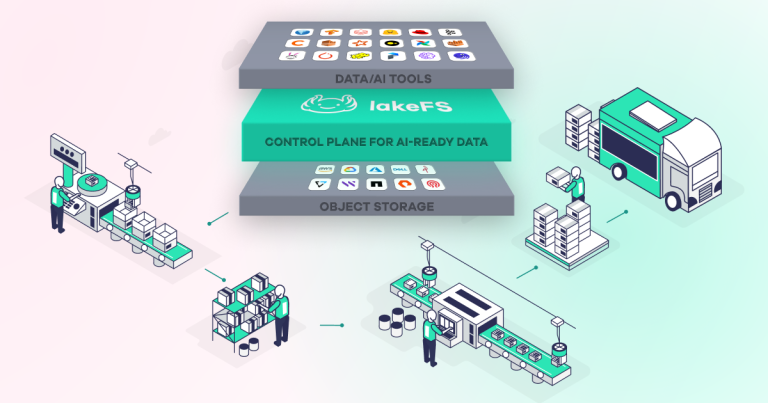
lakeFS is a scalable data version control system that provides Git-like capabilities for data, bringing manageability to data at any scale. It does so by applying software engineering best practices to data.
How can lakeFS help your teams achieve and maintain data compliance?
Here’s an overview of how lakeFS exemplifies a modern approach to data compliance:
- Data commit log – Every change applied to your data is versioned and fully traceable, enabling precise audits and rollback capabilities
- Built-in lineage and reproducibility – Team members can recreate and verify exact data states at any point using commit IDs, just like code, eliminating the guesswork and manual tracking that plague traditional approaches
- Isolated environments – You can create isolated branches to safely test data changes, transformations, and compliance checks before merging to production, preventing compliance violations from reaching live systems
- Automated compliance policy enforcement – lakeFS hooks let you automate checks before promoting data to production, enabling the Write-Audit-Publish pattern for safer, compliant workflows
- Works with your stack – lakeFS runs on top of object storage and integrates seamlessly with tools like Spark, dbt, Trino and data quality tools like Great Expectations, requiring no rip-and-replace of existing infrastructure
How lakeFS Helps Ensure Compliance in Practice
Governance & Access Control
lakeFS provides enterprise-grade governance features that traditional approaches struggle to deliver:
RBAC (Role-Based Access Control) enables fine-grained permissions by repository, branch, or path, giving organizations precise control over who can access what data and when.
Audit Logs automatically track and version every action, creating an immutable record of all data operations without manual intervention.
Centralized Identity Management integrates with SSO or cloud IAM roles, ensuring consistent authentication processes across all tools in your existing data stack.
Error Detection & Visibility
lakeFS transforms how organizations detect and investigate compliance issues:
The lakeFS commit log serves as a comprehensive data audit trail, providing complete visibility into data changes over time.
lakeFS makes it easy to inspect historical data versions, enabling faster, more accurate troubleshooting.
Metadata Search capabilities allow teams to search for sensitive data, such as missing or incorrect PII tags, and inspect changes across commits or branches for better visibility.
One common use case is for teams to quickly identify files that violate classification policies or are missing required annotations, and then trace back to the exact commit that introduced the violation.
Policy Automation for Error Prevention
lakeFS helps shift compliance from reactive detection to proactive prevention.
lakeFS Hooks run validations before commits or merges, such as blocking a merge if data lacks required metadata, ensuring compliance requirements are met before changes reach production.
Write-Audit-Publish Workflow ensures data is promoted only after validation checks (enforced with hooks) pass, creating a systematic approach to compliance that’s enforced automatically.
Branch Protection Rules enforce mandatory checks before merging, preventing direct writes to main branches and guaranteeing that pre-merge validations run before changes go into production.
Accelerating ML Model Audit
Deploying ML models often requires approval, whether from regulators in highly regulated industries or internal review in others. To get approved, teams must prove model reproducibility and auditability.
With data version control in place, thanks to its built-in functionality, they can easily demonstrate all the components required for approval. This helps reduce delays and friction in the deployment process.
Summary
lakeFS Enterprise offers a scalable, automated, and auditable foundation for modern data compliance that traditional approaches can’t match. Its native data versioning capabilities, combined with enterprise features gives teams confidence that data is properly governed, errors are detected early, and violations are prevented before they reach production.
By embedding compliance into the data lifecycle rather than bolting on it afterwards, lakeFS transforms compliance from a bottleneck into a competitive strength, improving reliability, accountability, and trust in your data operations.